We live in a world where almost everything can be typed.
Children learn with tablets. Teenagers take notes on laptops. Adults write emails, messages, documents, and social media posts without touching a pen.
And now, with AI, we can go one step further.
We can ask a tool to write an essay, organize our thoughts, create a story, brainstorm ideas, or even generate an entire piece of content in seconds.
So you might wonder:
Do we still need handwriting?
I think we do.
Not because handwriting should replace technology. It should not.
And not because every handwritten note is automatically better than something typed.
Handwriting matters for a different reason.
When you put a pen on paper, you are not simply entering words into a device. You are physically creating something that carries traces of your own decisions: the shape of your letters, the spacing between words, the pressure of your pen, the speed of your writing, and even the mistakes you decide to leave on the page.
That makes handwriting more than a basic school skill.
It can become a way to learn, think, practice, create, and express something that feels like your own.
The Benefits of Handwriting Begin in Childhood
For a child, writing a letter seems simple.
They see an “A,” pick up a pencil, and try to reproduce it.
But underneath that simple action, a lot is happening.
The child has to recognize the shape, remember how it is formed, coordinate their eyes and hand, control the pencil, and gradually learn how to reproduce the same movement again.
Handwriting brings together visual, motor, and cognitive skills in one activity.
Research on early literacy has found that handwriting experience can engage brain networks involved in letter processing and reading development. Other research has found that handwriting instruction can improve writing fluency in elementary-age students.
This is one reason handwriting should not be treated as something children simply have to “get through” before moving on to more important subjects.
The handwriting process itself is part of learning.
Handwriting Helps Children Learn Letters Through Movement
A child does not only need to know what a letter looks like.
They need to know how it moves.
Where does the line start?
Which direction does it go?
Where does it curve?
Where does it stop?
How does the next stroke connect?
These small movements gradually become familiar through repetition.
That is why handwriting practice can be much more meaningful than simply looking at an alphabet chart.
The child is not just seeing the letter.
They are building the letter with their own hand.
Handwriting Can Help Children Develop Writing Fluency
Imagine a child who has a great idea for a story but struggles to write each sentence.
If forming every letter requires a huge amount of effort, much of the child’s attention has to go toward the physical act of writing.
With practice, handwriting can become more automatic.
The child no longer has to think about every individual stroke.
That leaves more mental space for the actual message.
What do I want to say?
What happens next in my story?
How should I describe this?
What word should I use?
Research on handwriting interventions in young students has found meaningful improvements in writing fluency, although the results vary depending on the type of intervention and the students involved.
The point is not that handwriting practice magically makes every child a better writer.
The point is simpler:
When the physical act of writing becomes easier, children have more freedom to focus on what they want to communicate.
For Teenagers, Handwriting Becomes Personal
As children grow into teenagers, handwriting changes.
It is no longer just about learning how to form letters.
It becomes part of their identity.
Look at a classroom full of students and ask them to write the same sentence.
The words will be identical.
The pages will not.
One person may have small, neat letters.
Another may write quickly with a strong slant.
Someone else may prefer rounded letters and large spacing.
Some teenagers develop beautiful cursive.
Others develop handwriting that is messy but instantly recognizable as their own.
That individuality is valuable.
Handwriting Gives Teenagers a Way to Make Ideas Their Own
Teenagers are surrounded by digital content.
They see the same fonts, templates, videos, posts, AI-generated images, and polished designs every day.
Handwriting gives them something different.
A notebook does not have to look perfect.
You can cross something out.
Draw an arrow.
Write a word in the margin.
Circle an idea.
Sketch something next to a sentence.
Change your mind halfway through the page.
Nobody has to see it.
That freedom can be surprisingly useful for creativity.
A handwritten page can be messy because the purpose is not to produce a finished product.
The purpose is to develop the idea.
Handwriting and Learning
There is an ongoing discussion about handwriting versus typing for learning.
It is tempting to say that handwriting is always better.
The evidence is more complicated than that.
Different tasks benefit from different tools.
Typing is faster and extremely useful when you need to produce a large amount of text, search information, collaborate, or edit a document.
Handwriting, however, forces you to physically select and produce each word.
For some students, this can make note-taking a more deliberate process.
The important thing is not to turn the discussion into “paper good, technology bad.”
The better lesson is:
Use the tool that helps you think about the task in front of you.
Sometimes that tool is a laptop.
Sometimes it is a tablet.
Sometimes it is a pen and an empty page.
The Benefits of Handwriting for Adults
Many adults stop practicing handwriting once they leave school.
There is usually no reason to write the alphabet anymore.
But handwriting can still have a place in adult life.
Think about the last time you wrote something only for yourself.
Maybe you made a to-do list.
Maybe you planned a trip.
Maybe you wrote down an idea before going to sleep.
Maybe you kept a journal.
Maybe you simply wrote a few pages in a notebook.
There is something different about putting those thoughts on paper.
You are not writing for an audience.
You are not optimizing the wording.
You are not worrying about formatting.
You are simply thinking with a pen in your hand.
Handwriting Gives Your Thoughts a Physical Form
One of the things I like most about handwriting is that the page becomes a record of the thinking process.
You can see where an idea started.
You can see what you crossed out.
You can see the sentence you almost deleted.
You can see the arrow connecting two ideas that seemed unrelated at first.
A typed document often becomes cleaner as you edit it.
A notebook can preserve the mess.
And sometimes that mess is where the interesting ideas are.
Handwriting and Creativity in the Age of AI
This is where handwriting becomes even more interesting.
AI can now generate an incredible amount of content.
Give it a topic and it can give you ten ideas.
Ask for a story and it can write one.
Ask for a design concept and it can produce possibilities.
Ask it to rewrite something and it can give you several versions immediately.
That is useful.
But there is a danger if we allow convenience to replace our own creative process.
If AI always gives us the first idea, we may gradually become less comfortable with the uncomfortable part of creativity: having no idea what to do next.
Handwriting can give us a place to do exactly that.
Don’t Ask AI for the First Idea Every Time
Instead of immediately opening an AI tool, try opening a notebook.
Write the question at the top of the page.
Then write whatever comes to mind.
It does not have to be good.
It does not have to be grammatically correct.
It does not even have to make sense.
Write five ideas.
Cross out three.
Combine two.
Draw something.
Write another idea.
Then, when you have something that feels like yours, bring AI into the process.
Ask AI to expand it.
Ask it to challenge your idea.
Ask it to organize your notes.
Ask it to find weaknesses.
Ask it to help you turn your rough thoughts into something more polished.
Now AI is not replacing the beginning of your creative process.
It is helping you develop it.
Your Handwriting Is Personal
There is another reason handwriting matters in an increasingly automated world.
It is difficult to make someone else’s handwriting completely yours.
Your letters naturally develop their own characteristics.
Maybe your “a” is unusually round.
Maybe your “t” has a long crossbar.
Maybe your letters lean slightly to the right.
Maybe your capitals are large.
Maybe your spacing changes depending on how quickly you write.
These small details create a visual identity.
You can improve your handwriting without removing that identity.
In fact, the goal does not always need to be perfect handwriting.
Sometimes the goal should be:
Make your handwriting clearer while keeping it yours.
Handwriting Can Be Creative, Not Just Correct
This is especially true when you move beyond basic handwriting into lettering, cursive, and calligraphy.
You can experiment with different letter shapes.
You can change your spacing.
You can create different slants.
You can add flourishes.
You can combine words with drawings.
You can create your own lettering style.
At that point, handwriting stops being simply a method of recording language.
It becomes a visual form of expression.
And that is something worth protecting in a world where digital content is becoming increasingly standardized.
What About Children Growing Up With AI?
This may be one of the most important questions.
Today’s children will grow up with AI tools that can write, draw, explain, translate, summarize, and create.
They will have access to capabilities that previous generations never had.
That is exciting.
But children still need to develop their own ability to think, communicate, experiment, and create.
AI should give children more possibilities, not fewer opportunities to develop those abilities themselves.
Handwriting is one small but meaningful way to preserve that experience.
Give a child a blank page and ask:
“What do you want to make?”
There is no generated answer waiting for them.
They have to decide.
That decision is part of creativity.
How to Keep Handwriting in Your Life
You do not need to go back to doing everything by hand.
That would not make sense.
Instead, give handwriting a small, consistent place in your routine.
For Children
Let children practice letters, shapes, words, and short sentences.
Give them worksheets, blank paper, notebooks, and different writing tools.
Allow them to make mistakes.
Let them experiment.
Do not make every handwriting session about perfection.
The goal is to make writing familiar and enjoyable while gradually building control and fluency.
For Teenagers
Encourage handwritten notes, brainstorming, journaling, and creative writing.
Before opening a laptop to write an essay, try spending five minutes planning the main ideas on paper.
Before asking AI for ten ideas, write down three ideas yourself.
Then use technology to take the work further.
For Adults
Keep a notebook where you can easily reach it.
Write your priorities in the morning.
Practice your handwriting for five minutes.
Copy a paragraph from a book you enjoy.
Practice cursive.
Write down an idea before turning it into a digital project.
The goal is not to become disconnected from technology.
The goal is to make sure technology does not become the only place where you think.
A Simple Daily Handwriting Routine
You do not need an hour.
Try ten minutes.
Minutes 1–2: Warm up with lines, curves, and ovals.
Minutes 3–5: Practice individual letters or words.
Minutes 6–8: Write freely about an idea without worrying about mistakes.
Minutes 9–10: Experiment with your handwriting style.
Change the size.
Try a different slant.
Practice a few capital letters.
Add a simple flourish.
There is no grade.
There is no deadline.
You are simply giving yourself ten minutes to write.
Handwriting Does Not Need to Fight AI
I don’t think the future should be about choosing between handwriting and technology.
We should use both.
Use AI when you need speed.
Use a keyboard when you need to produce and edit large amounts of text.
Use digital tools when you need to collaborate.
But keep handwriting when you want to slow down.
Use it when you want to brainstorm.
Use it when you want to practice.
Use it when you want to remember something.
Use it when you want to create something that feels personal.
And sometimes, use it simply because there is something satisfying about seeing your own handwriting on a page.
The Future Needs More Than Perfect Content
AI is becoming very good at producing polished results.
That makes human imperfections more interesting, not less.
A handwritten page does not have to compete with AI-generated content.
It serves a different purpose.
It shows the process.
It shows the person.
It shows the choices.
It shows the little imperfections that make the work yours.
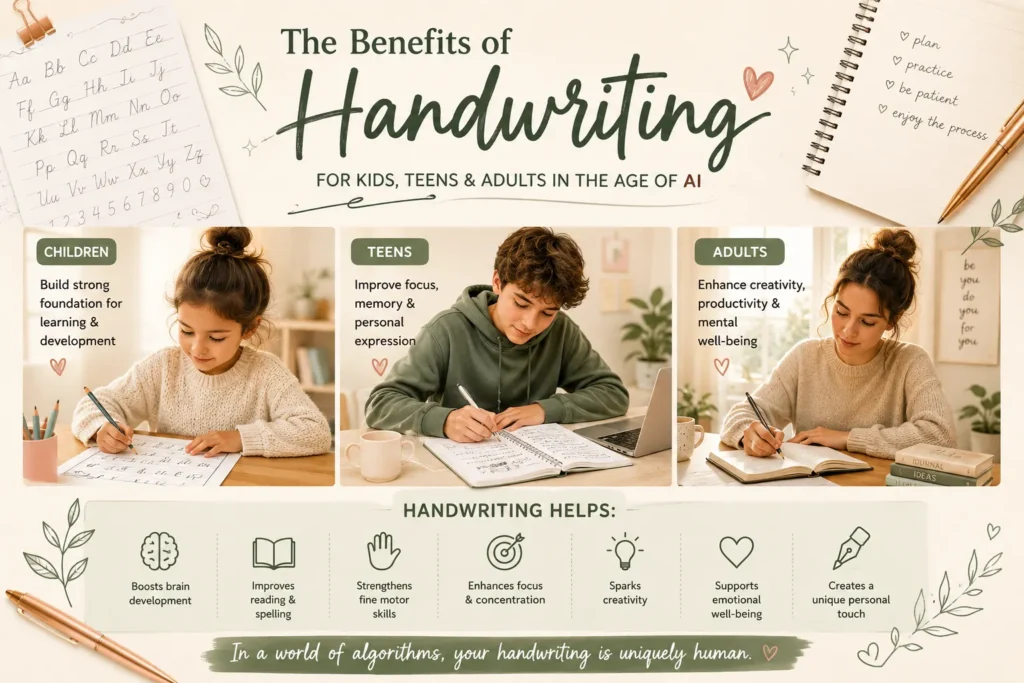
For children, handwriting can be part of learning how written language works.
For teenagers, it can become a tool for learning and self-expression.
For adults, it can remain a simple way to think, plan, practice, and create.
And in the age of AI, perhaps the most important benefit is this:
Handwriting gives us a place where the first idea can still come from us.
AI can help us develop that idea.
But we should not give away the entire creative process simply because a machine can do it faster.
Start With One Page
You do not need to change your entire routine.
Take one sheet of paper.
Pick up a pen.
Write one paragraph.
Practice one letter.
Draw a few ovals.
Write down one idea before asking AI what it thinks.
That is enough to start.
Handwriting is not about going backward.
It is about keeping another way of thinking, learning, and creating available to us.
And sometimes, in a world that is becoming increasingly digital and automated, doing something slowly and personally is exactly what makes it valuable.
Ready to practice?