
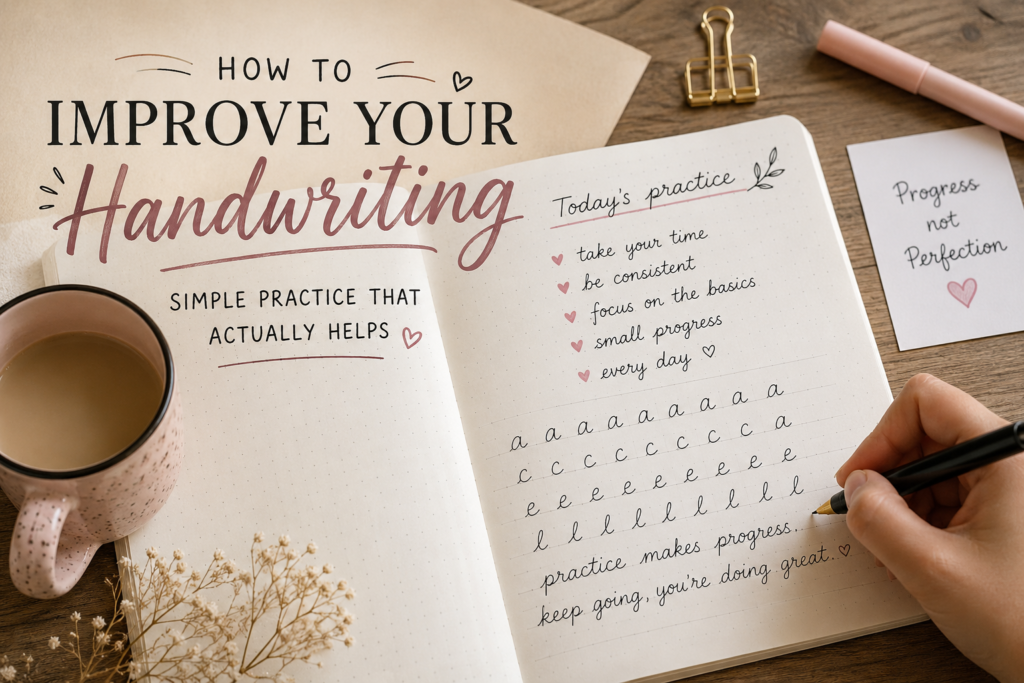
I used to think that having neat handwriting was something you were simply born with.
Some people could pick up a pen and immediately write beautiful, balanced letters. Mine never looked quite like that. Some days the letters were too small, some days they were too big, and by the end of a page, my handwriting would slowly become messier.
That was one of the reasons I started paying more attention to handwriting practice.
Over time, I realized that improving handwriting isn’t really about trying to make every letter look perfect. It’s much more about learning how to control the size, spacing, and movement of your writing.
And you don’t need to spend hours practicing.
Even 10 minutes a day can make a noticeable difference if you practice consistently.
Start With the Way You Hold Your Pen
Before changing your handwriting, I think it’s worth looking at something very simple: the way you hold your pen.
When I write for a long time, I sometimes notice that I start gripping the pen too tightly. My hand becomes tired, my strokes become less relaxed, and naturally my handwriting becomes less consistent.
Try relaxing your fingers and letting the pen move more naturally.
You don’t have to copy someone else’s exact grip. The important thing is that your hand feels comfortable enough to write for several minutes without becoming tense.
Don’t Try to Fix Everything at Once
This is probably one of the biggest mistakes beginners make.
You look at your handwriting and see ten things you don’t like.
The letters are uneven.
The spacing isn’t consistent.
Some letters are too large.
Some words seem to slowly move upward or downward across the page.
If you try to fix all of these things at once, handwriting practice can quickly become frustrating.
Instead, choose one thing.
For example, this week I might focus only on keeping my lowercase letters around the same height.
Once that starts feeling natural, I can work on spacing.
Small improvements are much easier to notice when you give yourself only one thing to concentrate on.
Practice Letters Slowly First
When practicing a new letter, don’t worry about speed.
Write it slowly several times and pay attention to the movement of your hand.
For example, if you’re practicing the letter a, don’t just write:
a a a a a a
and move on.
Look at the shape.
Does the letter stay around the same size?
Does it sit on the same baseline?
Does the second a look similar to the first one?
This kind of repetition may feel boring at first, but that’s actually where the improvement happens.
Your hand gradually becomes familiar with the movement.
Then Practice the Same Letter Inside Words
Once a letter feels comfortable by itself, put it into a word.
For example, after practicing a, try:
apple
always
handwriting
practice
This is where things start to become more interesting because writing individual letters and writing naturally are two different skills.
A letter might look great when you practice it by itself but completely different when you’re writing quickly inside a word.
That’s completely normal.
Keep practicing.
Pay Attention to Spacing
Sometimes handwriting doesn’t look messy because of the letters themselves.
It’s the spacing.
When the letters are too close together, words become difficult to read. When the spaces between words are too large, the whole sentence can look disconnected.
Try writing the same sentence several times while changing only the spacing.
For example:
Practice makes progress.
Don’t worry about making it beautiful.
Just try to make the distance between your letters and words feel consistent.
This small change can make handwriting look much cleaner.
Try a Simple 10-Minute Practice Routine
You don’t need a complicated routine.
When I practice, I prefer something simple enough that I can actually keep doing it.
Start with a couple of minutes of basic lines and curves. Then spend a few minutes practicing individual letters. After that, write a few words using those letters.
Finish by writing one or two short sentences.
That’s it.
Ten minutes doesn’t sound like much, but doing it regularly is more important than having one very long practice session and then forgetting about it for a week.
Use a Worksheet Instead of a Blank Page
One thing I find helpful about handwriting worksheets is that they remove the question of what to practice.
When you have a completely blank page in front of you, it’s easy to write a few sentences and stop.
A worksheet gives you something specific to follow.
You can repeat the same letter, compare your writing with the example, and gradually move from letters to words and sentences.
That’s also why I created the printable worksheets here at MSPenLetters.
The idea is simple: give yourself a small amount of structured practice and make it easy to come back tomorrow.
Give Yourself Time
Your handwriting probably won’t change dramatically after one practice session.
And honestly, I don’t think it needs to.
The goal isn’t to suddenly develop someone else’s handwriting.
Your handwriting should still feel like yours.
Maybe your letters become a little more consistent. Maybe your words become easier to read. Maybe your writing feels less rushed.
Those small changes add up.
If you practice for just 10 minutes a day, you can build a surprisingly large amount of practice over a month.
And the best part is that you don’t need anything complicated.
A pen, some paper, and a little time are enough to start.
Ready to Practice?
If you’d like something more structured than a blank piece of paper, I’ve created free printable handwriting worksheets that you can use at home.
Choose a worksheet, print it on A4 or US Letter paper, grab your favorite pen, and start with just a few minutes of practice.
Don’t worry about making every line perfect.
Just keep going.
[Get the Free Handwriting Worksheet →]
I’ll be adding more handwriting practice sheets and resources to MSPenLetters, so if you’re working on your handwriting too, there’s plenty more to practice.
Final Thought
I think the nicest thing about handwriting is that it doesn’t have to be perfect to be personal.
Your handwriting is something you create every time you put a pen on paper.
So instead of trying to completely change it, try making it a little better each day.
One letter.
One word.
One page at a time.